
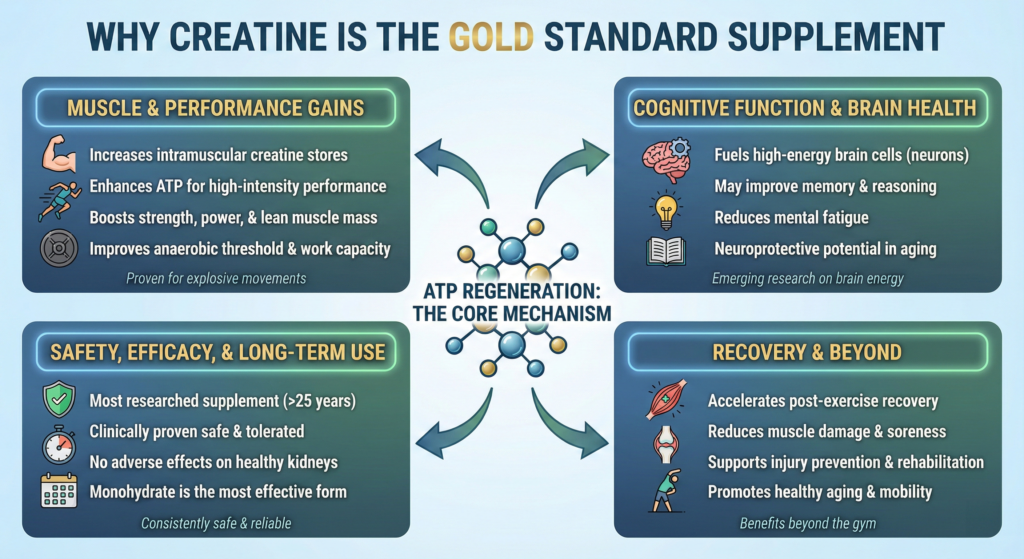
Introduction: Why Creatine Remains the Gold Standard
In the crowded landscape of sports nutrition, one compound stands unchallenged as the most scientifically validated ergogenic aid available: creatine supplement for muscle growth. Decades of peer-reviewed research consistently demonstrate that this naturally occurring molecule delivers unparalleled improvements in strength, power output, and lean body mass accretion. Unlike fleeting fitness trends or proprietary blends shrouded in marketing hyperbole, creatine monohydrate boasts over a thousand published studies supporting its efficacy and safety profile.
Whether you are a seasoned powerlifter seeking to break through strength plateaus or a novice trainee aiming to maximize your newbie gains, understanding how to leverage creatine effectively can accelerate your hypertrophic potential by significant margins. This comprehensive guide dismantles the complexity surrounding supplementation protocols, examines the cellular machinery driving muscular adaptation, and provides actionable strategies to optimize your results.
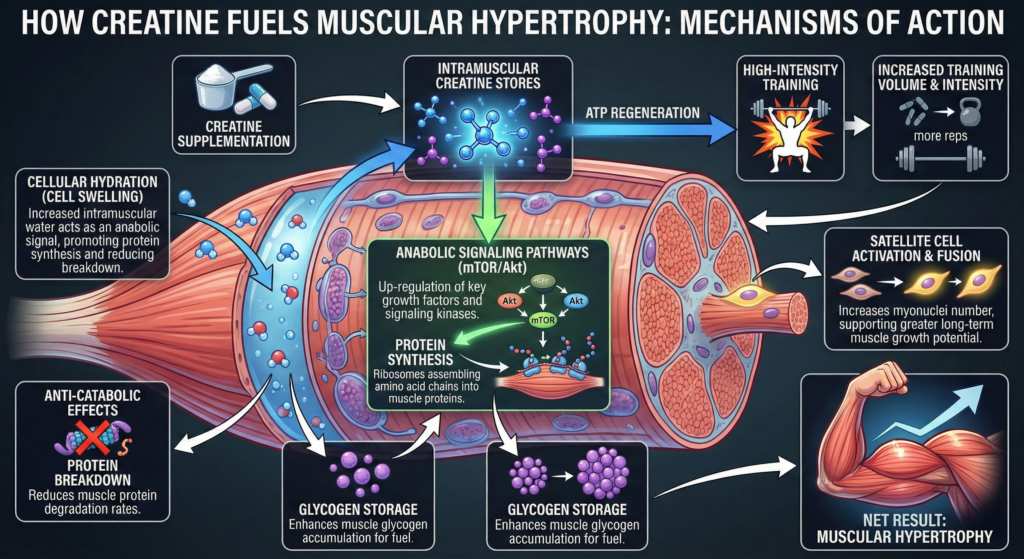
Cellular Mechanisms: How Creatine Fuels Muscular Hypertrophy
To appreciate why creatine supplement for muscle growth proves so effective, one must examine the bioenergetics of high-intensity resistance training. During explosive movements such as heavy squats or sprint intervals, your muscles rely primarily on the phosphagen system, which regenerates adenosine triphosphate (ATP) through the phosphocreatine shuttle. Supplemental creatine increases intramuscular phosphocreatine stores by up to 40%, dramatically accelerating ATP resynthesis and allowing you to perform additional repetitions before fatigue accumulates.
Beyond mere energy provision, creatine induces significant cellular volumization—drawing water into muscle fibers and creating an anabolic environment conducive to protein synthesis. This osmotic effect triggers signaling cascades including the mTOR pathway and increases satellite cell proliferation, essential mechanisms for myofibrillar hypertrophy. Furthermore, elevated creatine concentrations buffer lactic acid accumulation, reducing muscle pH decline and extending time-under-tension during hypertrophy-focused training sessions.
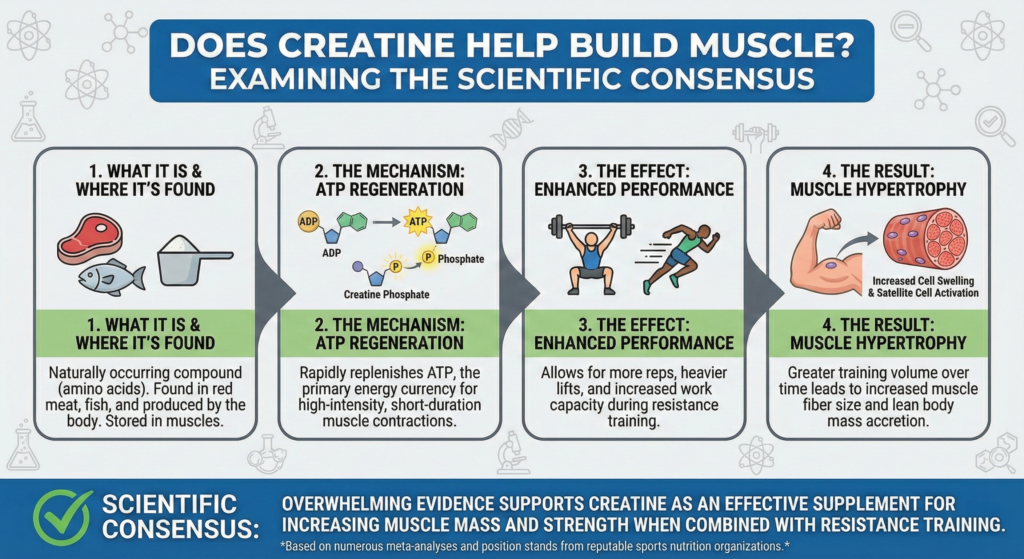
Does Creatine Help Build Muscle? Examining the Scientific Consensus
The empirical evidence supporting creatine supplement for muscle growth is overwhelming and unambiguous. Position stands from the International Society of Sports Nutrition (ISSN) and the Journal of the International Society of Sports Nutrition confirm that creatine monohydrate remains the single most effective nutritional supplement for increasing high-intensity exercise capacity and lean body mass when combined with resistance training.
Meta-analyses reveal that creatine supplementation produces average strength gains of 5-15% and lean mass increases of 1-2 kilograms within the initial 4-12 weeks of training, independent of other variables. These effects prove particularly pronounced in vegetarians and vegans, who typically maintain lower baseline muscle creatine stores due to dietary absence of meat and fish. While individual responses vary—approximately 20-30% of the population possesses naturally saturated creatine levels and demonstrates minimal additional benefit—the vast majority of users experience measurable improvements in muscular endurance, recovery velocity, and cross-sectional muscle fiber area.
Longitudinal studies tracking users for up to five years confirm sustained benefits without tolerance development, establishing creatine not merely as an acute performance enhancer but as a long-term hypertrophy accelerator.
Comparative Analysis: Identifying the Best Creatine for Building Muscle
Despite market proliferation of novel formulations, creatine monohydrate remains the unequivocal gold standard for creatine supplement for muscle growth. Its molecular structure demonstrates near-complete bioavailability, with decades of research validating its absorption kinetics and efficacy. Micronized versions offer improved solubility in aqueous solutions, reducing gastrointestinal distress for sensitive individuals without altering the fundamental pharmacokinetics.
Alternative forms such as creatine hydrochloride (HCl) claim superior solubility and reduced dosing requirements; while these assertions hold merit for those experiencing bloating with monohydrate, they lack the extensive performance data supporting traditional formulations. Buffered creatine (Kre-Alkalyn) and creatine ethyl ester have consistently failed to demonstrate enhanced muscle uptake or retention compared to monohydrate in controlled trials, with some research suggesting ethyl ester actually converts to inactive creatinine at higher rates.
Liquid creatine preparations should be avoided entirely, as creatine degrades to creatinine when suspended in solution for extended periods. For maximum cost-effectiveness and proven results, pharmaceutical-grade creatine monohydrate powder provides optimal value, requiring only 3-5 grams daily to maintain saturated intramuscular stores.
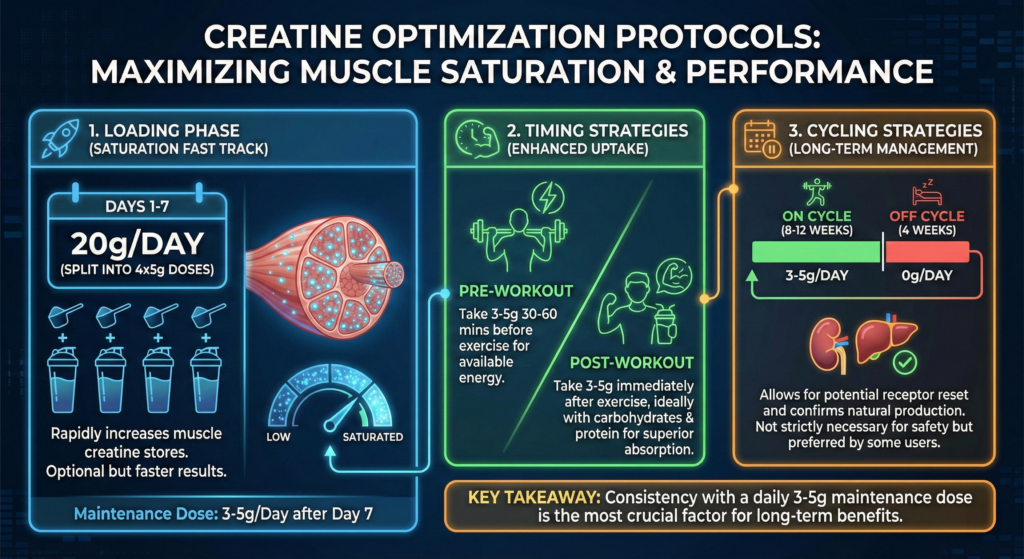
Optimization Protocols: Loading, Timing, and Cycling Strategies
Maximizing the benefits of creatine supplement for muscle growth requires strategic implementation rather than haphazard consumption. Two primary dosing paradigms exist: rapid loading and steady saturation. The loading protocol involves consuming 20 grams daily, divided into four 5-gram servings, for 5-7 days to rapidly saturate muscle creatine stores, followed by a maintenance phase of 3-5 grams daily. Alternatively, skipping the loading phase and consuming 3-5 grams consistently will achieve full saturation within approximately 28 days with fewer potential digestive side effects.
Regarding timing, emerging evidence suggests post-workout consumption may offer slight advantages over pre-workout dosing, particularly when co-ingested with high-glycemic carbohydrates and protein to enhance insulin-mediated uptake. However, consistency trumps timing precision; the chronic elevation of intramuscular creatine matters more than acute pre-exercise spikes. Contrary to outdated bodybuilding lore, cycling is unnecessary; continuous supplementation maintains elevated stores and produces superior long-term adaptations compared to intermittent protocols.
Safety Profile, Hydration, and Debunking Common Myths
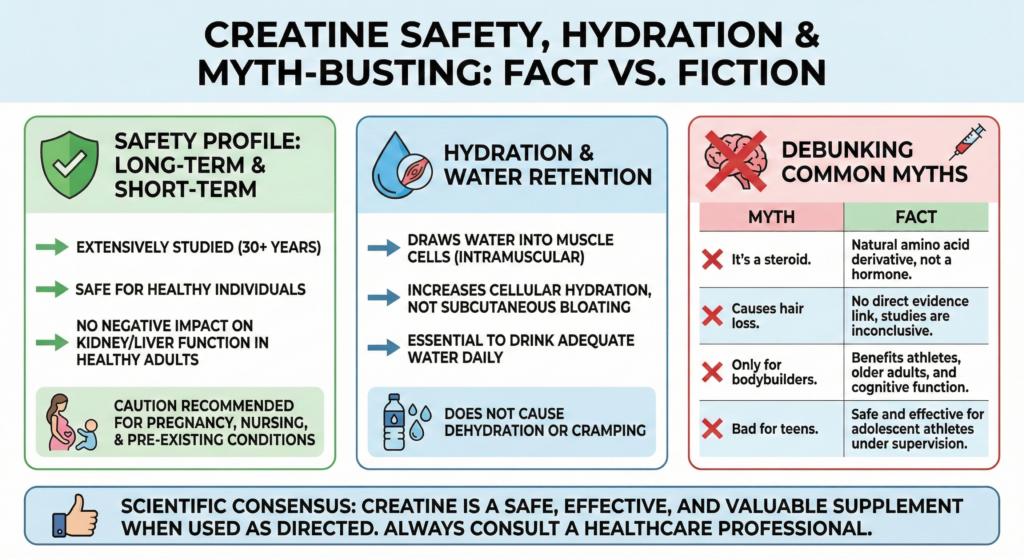
The safety record of creatine supplement for muscle growth remains exemplary across diverse populations, including adolescents, elderly individuals, and clinical patients. Comprehensive reviews examining renal function markers in healthy users consuming up to 10 grams daily for five years reveal no adverse effects on kidney filtration rates or liver enzymes. The persistent myth linking creatine to renal damage stems from misinterpreted case studies involving individuals with pre-existing kidney pathology.
While creatine increases intramuscular water content, it does not cause dehydration or cramping; conversely, research indicates it may reduce heat-related illness and cramp incidence during endurance activities in hot environments. Concerns regarding hair loss and elevated dihydrotestosterone (DHT) levels require cautious interpretation—a single study noted modest DHT increases in rugby players, but subsequent research failed to replicate these findings or establish causal links to androgenic alopecia in genetically predisposed individuals.
Synergistic Integration: Training Periodization and Nutritional Support
To fully exploit creatine supplement for muscle growth, integration with progressive resistance training and nutritional optimization proves essential. Creatine demonstrates maximal efficacy when paired with systematic overload protocols emphasizing mechanical tension and metabolic stress—specifically compound movements performed in the 6-12 repetition range with controlled eccentric phases.
Nutritionally, combining creatine with β-alanine creates complementary ergogenic effects, as carnosine buffering synergizes with creatine phosphate regeneration to extend high-intensity performance capacity. Post-workout consumption alongside 30-50 grams of fast-acting carbohydrates and 20-30 grams of complete protein maximizes insulin-driven nutrient partitioning and glycogen resynthesis. Additionally, maintaining adequate dietary protein intake (1.6-2.2g per kilogram bodyweight) ensures sufficient amino acid availability to capitalize on the enhanced protein synthesis rates creatine facilitates. Prioritizing sleep quality and managing cortisol levels further amplifies the anabolic milieu, allowing trainees to translate increased work capacity into tangible hypertrophy.
Implementation Roadmap and Final Recommendations
Begin your creatine supplement for muscle growth journey by selecting a reputable third-party tested monohydrate powder. Initiate supplementation with a standard 5-gram daily dose, mixed thoroughly in water or your post-workout shake. Maintain this protocol consistently, tracking strength metrics and body composition changes over a minimum four-week assessment period to account for saturation delays.
Combine this supplementation with progressive overload training, adequate protein intake, and sufficient caloric support for your specific goals. Avoid overcomplicating your approach with unnecessary cycling, loading phases (unless immediate performance is critical), or expensive alternative formulations. By treating creatine as the foundational ergogenic aid it is—rather than a magic bullet—you establish the physiological conditions necessary for sustained muscular hypertrophy and long-term strength development.